ServicesAutomated Salt Delivery
Automated Salt Delivery in Citrus Park
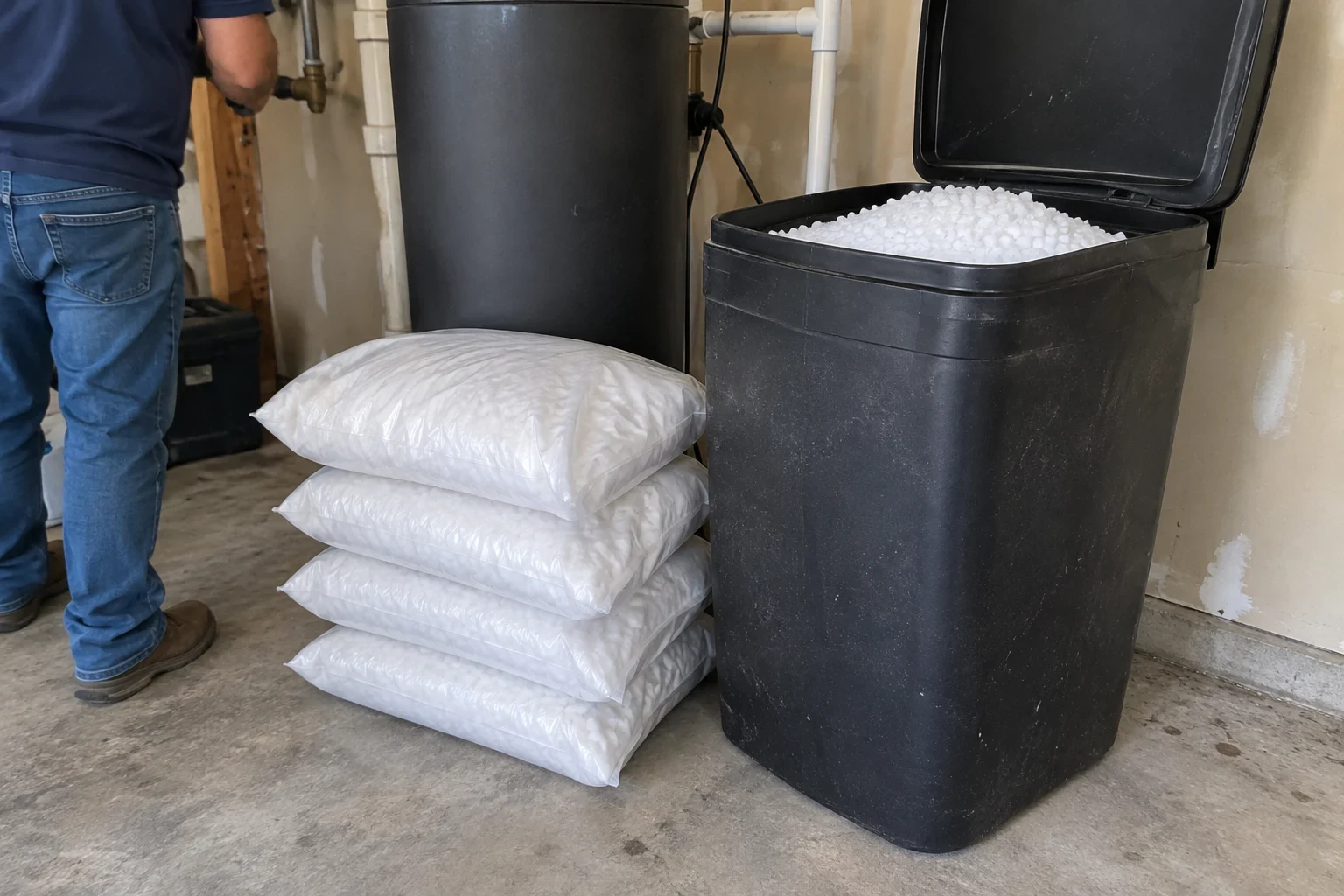
Softener salt arrives at your home on a rhythm set by your household's water use, and we pour it into the brine tank ourselves. No more wrestling heavy bags out of the car, and no stretch of weeks where the softener sits empty without anyone noticing.
Salt handled, so your softener keeps working
Softening depends entirely on brine. Once the salt runs out, the resin can't recharge, and hard water flows on to your faucets and appliances. It can go on for weeks before cloudy glassware or a chalky film on the shower door gives it away.
With automated salt delivery, that job becomes ours. We figure out your system's rate of salt use, choose a product that suits it and return at a steady interval to refill the tank. In the West Valley, where hard water is common, an uninterrupted supply is what lets a softener actually soften.
You deal with one person throughout. Whoever sets up your schedule is also who you reach to switch salt, skip a visit or ask about something odd in the tank, and they keep every delivery on track.
What each delivery includes
- Bags carried in and poured
- Garage, utility closet or side yard, we take the salt right to the softener and empty the bags into the tank. Nothing gets left in a pile by the front door.
- Brine tank checked for bridging
- Salt can fuse into a hard shelf above the water, so a tank looks full while the brine underneath is spent. We probe for that crust on each visit and break it apart so fresh salt can dissolve.
- Salt suited to your softener
- We pair the product with your unit: high-purity evaporated pellets, solar crystals, or potassium chloride for anyone who wants to skip sodium. Purer salt builds up less sludge in the bottom of the tank.
- Intervals based on real use
- Your visit spacing comes from the softener's capacity and your home's actual water use rather than a generic calendar. When your household grows or shrinks, the spacing changes with it.
- Empties gone, floor swept
- Used bags leave with us, and any loose salt around the tank gets swept up before we go.
- An honest note if something's off
- Water sitting unusually high in the tank, or salt that hasn't dropped since last time, gets mentioned to you along with what it might mean.
Signs it's time to hand off the salt
The tank keeps running low
If you find the salt below the water line more than once, the softener has likely gone through regenerations without brine. Hard water has been reaching your pipes in the meantime.
Spots and scale are back
White spots on dishes, crusty faucet aerators and stiff towels after a softener had been working well usually point to an empty or bridged tank, not a failed unit.
Lifting bags is a strain
Softener salt comes in heavy bags, and brine tanks often sit in tight corners. If carrying them has become hard on your back, it is a sensible job to pass along.
Salt sits but never drops
When the level stays the same for weeks, a bridge may have formed. Monsoon humidity in a closed garage can help that crust set.
Refills depend on memory
Travel and busy weeks make it easy to miss a top-up. A set schedule means the softener stays supplied without anyone having to remember.
What shapes the cost of salt delivery
Two things drive most of the price: the amount of salt your softener goes through and the kind of salt you pick. We go over both on the phone before anything is scheduled, so you know what a visit covers and what it costs.
Salt type
Potassium chloride runs noticeably higher than sodium chloride. Within sodium salt, evaporated pellets and solar crystals also differ in purity and price.
Your household's water use
More people and more laundry mean more regenerations, and each one draws on the brine. That translates into extra bags per visit or a shorter gap between visits.
How efficient the softener is
Older timer-controlled units regenerate on a set clock, used water or not. Demand-initiated models only regenerate when the water calls for it, so they usually cost less to keep stocked. If yours is an older model, our Water Softener Installation page covers what replacing it involves.
Access to the tank
Reaching a brine tank in a roomy garage takes far less time than reaching one tucked in a narrow closet or past a locked side gate. How easy the tank is to get to can shape both visit length and scheduling.
How setup and delivery work
- 1
A short call to start
We ask which softener you have and its size, where it's installed, the size of your household and the salt in the tank today. From those answers we can rough out a first schedule.
- 2
Settling salt and spacing
We suggest a salt and a visit interval, walk you through why, and only lock it in once you agree. If the softener's settings seem mismatched to your water use, we'll point that out.
- 3
The delivery visit
We show up within the agreed window, inspect the brine tank, clear any bridge, pour in the salt and clean up. Visits tend to be brief and quiet.
- 4
Adjusting as we learn
Over the first few visits we record how much salt remains each time and tighten or stretch the interval to match. Pausing, skipping or changing anything is one call to the same contact.
Questions about salt delivery
Do I need to be home for deliveries?
Not necessarily. If your softener is in a garage or side yard we can reach, many customers arrange access so we can deliver while they are out. We will talk through what works for your home when we set up the schedule.
Can you deliver for a softener you didn't install?
Yes. Delivery works with most standard softeners that use a brine tank. We ask about the brand and model when you call so we bring a salt that suits it.
What's the difference between pellets, crystals and potassium?
Evaporated pellets are the purest sodium chloride and leave the least sediment. Solar crystals are a little less refined and cost less. Potassium chloride replaces sodium entirely, which some people prefer, though a softener typically needs more of it to do the same work.
How often will you come?
That depends on your softener's capacity and how much water your home uses. Some homes need a visit every few weeks, others far less often. We set a starting interval and adjust it after seeing how the level changes.
Can I change or pause the schedule?
Yes. Call the same person who set it up and say what you need, whether that is a pause for travel, a different salt or an extra visit before guests arrive.
Will you tell me if my softener seems to have a problem?
We tell you what we see in the tank on every visit. If the unit itself looks like it is near the end of its life, we explain that honestly and can talk through replacement under our Water Softener Installation service.
Let someone else keep the tank full
One call settles your salt type, your schedule and how we reach the softener. After that, the same person handles every change.